


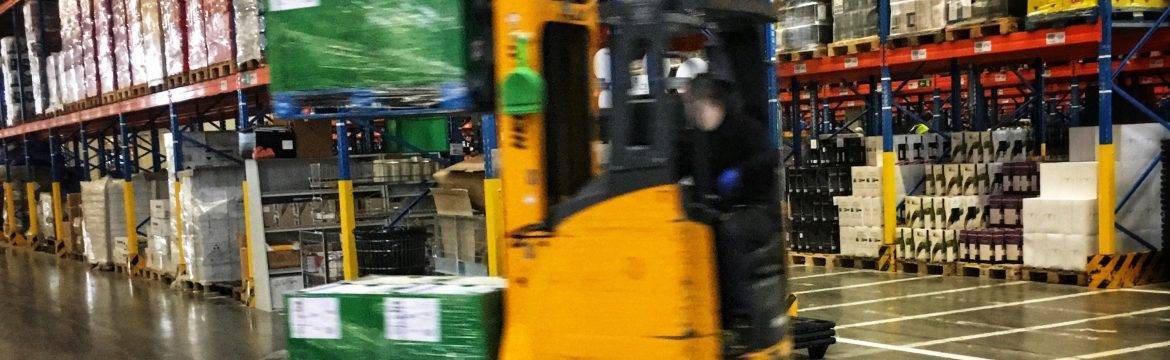
The famous lift truck, the most popular tool for those who own a transportation industry, carries a very interesting history.
Its colloquial name, “muletto”, was first introduced not so many years ago (early 1950s), with the idea of finding a more immediate name for a quick and very useful tool.
Today, we will find out together how this term originated and what its actual origin is. We will find out more about forklifts and their presence within businesses.
In this way, you will be able to fill your curiosity and add more to your cultural background.
Knowing the origin of words is often more interesting than expected, because it allows us to tell an unknown story belonging to the past.
The story of the forklift
The forklift can be described as a simple “operating vehicle,” a tool equipped with wheels and driven by an engine (electric, gas or diesel).
It is used in the warehouse industry for loading and unloading goods, used for its ability to lift and move products.
The birth of the forklift dates back to the 1920s, when the first lift truck was invented by Eugene Clark, an American mechanic.
Over the years, the medium has become increasingly well-known and exploited. Its spread went hand in hand with that of the use of pallets, which were essential for businesses as early as the end of World War II.
The initial model has been modified to become more ergonomic and more practical; controls have been improved to make driving and moving easier; and safety measures have been increased to better protect the driver.
Current models often feature an on-board multifunction display, where all the key information concerning the truck can be controlled and displayed. From the operating mode to the hours of operation, through to the state of charge and maximum transportable weight.
The manual transmission has been abolished in favor of automatic transmission, a safe steering system has been added, and several technological and structural improvements have been introduced-with the aim of improving the truck’s performance.
Modern enterprises focus on speeding up transportation as much as possible, making sure that the forklift accompanies drivers through every stage of loading and unloading, avoiding mistakes.
Today there are a great many brands involved in the production of high-quality forklifts, operating mainly at the local level. Speaking globally, however, the leading brand in the industry remains Toyota, which has been working for years on the production of increasingly complete forklifts.
The origin of the name
Now that we have found out what the history of the forklift is, we can focus on the origin of the name muletto, find out where this cute “nickname” came from.
Apparently, the term muletto was first introduced around 1949, in Germany.
At the time, the Still factory named its first electric-powered forklift truck-“Mules.” In these days, it was not unusual to associate specific work tools with the names of the animals that previously performed their functions.
If previously the load was carried, lifted and moved by mules, today the “muletto” is used in the same way.
A few years later than the introduction of the Still factory, the first electric trucks began to arrive in the port of Genova.
Before long, the habit of calling them muletto spread among workers, a habit that has never disappeared and has continued to spread to this day.
Here, then, is an explanation of why the forklift is also called muletto.